Clinically aligned simplification
"the ends justifies the means"
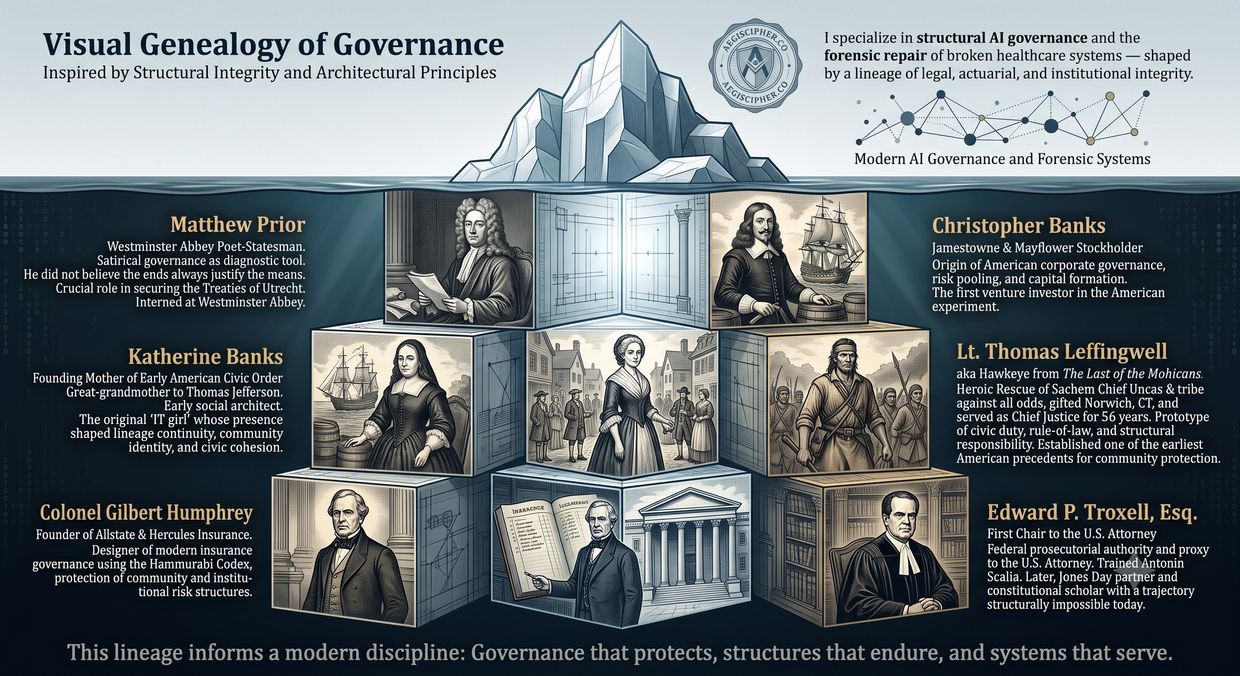
... satire ... by Matthew Prior
In healthcare, the care of health,
the means drives the ends
"the ends justifies the means"
... satire ... by Matthew Prior
In healthcare, the care of health,
the means drives the ends
Product marketing pits payor against provider for profit. This is unethical and ignores deterioration caused by outsourcing.
We are in an industry where lives, vitality, and ability to work are impacted by the process. Persona, sources of truth, process must match medical policy, program covenants, clinical integrity.
At a recent session of the National Sciences series on primary care, the discussion of AI as an emerging technology was on the agenda. It is critical for anyone in capability enablement to remember technology is NOT first. There are no "technology mandates" and friction & abrasion is a form of triangulation.
The tipping point comes when “EMR integration,” “UM transformation,” and “patient engagement” are defined by people who are not accountable for care delivery.
That is when good intentions harden into structural failure. An EMR postmortem should be evaluated ahead of any "EMR transformation" product line or strategic roadmap. The other non-negotiable is for design due diligence and go to market execution must follow a six sigma or process improvement step of confirming the original design, current state, future state and gap assessments.

The Core Failure Mode
Across healthcare and emerging technologies; the most common mistake is the Minimum Viable Product (MVP) before defining Minimum Value Expected (MVE).
MVE is the minimum outcome the end user must experience for the product to be viable in practice. When that standard is missing, drift is inevitable.
· You cannot define a MVE if the clinicians haven’t defined the problem.
· You cannot define the solution space if the problem space is ambiguous.
· You cannot define requirements if the clinical use case is undefined.
· You cannot define value if the pain point is not articulated.
.jpeg/:/rs=w:400,cg:true,m)
“We got feedback” is not the same as proving people will adopt it, pay for it, or trust it to replace work. If feedback is gathered, the loop must be closed. Clinicians and customers should not be expected to donate expertise to support someone else’s monetization strategy. Respect is demonstrated by showing what changed, what did not, and why.
If you ask for input, you need a disciplined response: what is being used now, what is planned next, what already exists with similar value, and what has been deferred. A thoughtful “no” builds more credibility than vague acknowledgment ever will.
.png/:/cr=t:0%25,l:0%25,w:100%25,h:100%25/rs=w:400,cg:true)
Today: we see an uptick of Rx; we need more generic dispensing. We have more claims for back injury, it must be fraud, request records for 18 years.
Incidence and Prevalence based: we see for heavy occupations in the airline industry, there are more recurrent absences, and those absences are on average 2 weeks longer.
Employer: Confirmation of their baggage handler and mechanics. In exploration, we see that shifts are being moved to 2-3 days in a row and for 12-hour shifts. Ergonomic check, employees benefit from 8-hour shifts, being fitted for a truss and orthopedic advice is it is beneficial for physical therapy or ergonomic reviews for those with absences. Consider back-to-back for 2 days and 12-hour shifts after absence only if signed off by a physician.
· Absence: $18,000,000/year - after $10,000,000
· Health costs: $9,000,000 before - after $6,000,000
· Accommodation Cost: $2,500,000
In this situation, the Airline presents the plan to the Union, the Union presents it at their annual meeting. Both the Union and Airline have parted in making the employees feel supported. Physicians are also able to suggest solutions for other scenarios, often ahead of when they present on dashboard.

1 – Reintroduce Diagnostics
Utilization Management and AI 1.0 for collaborative treatment plan coordination and not a procedure approval. Medical policy and plan program guides were in the original but today, generic hospital guidelines. The use case persona was the Plan UM nurse, not provider.
2 – Use the Data that already exists
60% of clinical information in the care and administrative continuum flows is neither EDI nor FHIR. 45% of authorizations are via fax, 25% of this is integrated. 0% of it is captured in SAAS or EDI. Using what data exists first becomes the business case for more 12 and FHIR adoption.
3 – Align healthcare to absence management
10% drives 50% of healthcare costs. The disability claim requires medical attestation. There is not a single scenario where a disability claim does not have core medical information, primary and secondary and acuity. The records request becomes the exception. Group benefits have already solved this.

A 20-year lookback on due diligence, partnerships, and ecosystems reveals the rigorous roadmaps that have guided HIT delivery. As we embrace AI in healthcare and navigate emerging technology transformation, the focus on security remains paramount.
This satirical overview highlights the top 10 issues where the conflation of health care and the adjudication of claims must be addressed, particularly in the context of AI in healthcare and the emerging technology transformation driving healthcare innovation.
The road to somewhere involves vetting, especially when considering the role of AI in healthcare. It's essential not to move fast and break things in this sector. Instead, we should focus on approaches that can enhance the effectiveness of health information technology.

Collaborative transformation & Sustained innovation, particularly with the integration of AI in healthcare, requires a process of creative destruction as part of the emerging technology transformation.

Adding dimensions while simplifying population health through innovative healthcare solutions, leveraging AI in healthcare for greater benefit, trust, and quality amidst the emerging technology transformation.

The 1984 Apple playbook offers insights into how to curate emerging technology transformation to harmonize within healthcare ecosystems, especially with the rise of AI in healthcare driving innovation.
The regulations exist, market entrants must understand the rules proactively.

$12T cyber-criminal reference guide, highlighting the impact of healthcare innovation on security.

AI is an enablement feature that plays a crucial role in healthcare innovation
National Provider Directory (pdf)
DownloadDarwin Awards Healthcare (pdf)
DownloadFHIR Rip Replace Reality (pdf)
DownloadWatson 1.0 AI Healthcare My Role Experience (pdf)
DownloadAI Lobbying and Reform not DeReg (pdf)
DownloadInsurances First Pop Health Framework (pdf)
DownloadAward winning thought leadership (pptx)
DownloadThe Dartmouth Paper AI Academic Launch- 1956 (pdf)
Download2025 11 CMS Interop and EHR Assessment vfs (pdf)
DownloadAegisCipher_AI_Governance_Contract_Reference_v3s (pdf)
DownloadAutopsies_Healthcare_SaaS_UM_2 (docx)
DownloadKissinger on AI (pdf)
DownloadAegis Cipher Minimum Necessary v4 (pdf)
DownloadAegisCipher_AI_Governance_Contract_Reference_v3s (pdf)
Download
A growing concern and fail point for the transformation of emerging technology, particularly in the context of AI in healthcare, is the lack of collaboration with end users and the failure to address operational and organizational processes essential for effective healthcare innovation.
Emerging technologies serve as a vehicle for innovation rather than a standalone strategy. In the context of healthcare innovation, AI in healthcare proves to be most effective as a solution focused on task-level execution, rather than attempting to replace human reasoning.
Emerging technology transformation demands more upfront consideration to achieve success, particularly when discussing AI in healthcare. The essence of business remains the same; the business of healthcare is fundamentally about the care of health. It is crucial that we do not conflate the adjudication of claims with the core mission of healthcare innovation.
Aegis: Protection, sponsorship, patronage, guidance, direction, or control.
Cipher: A secret code, usually one created using a mathematical algorithm.
Aegis Cipher exists to serve as a steward ensuring that emerging technology transformation, particularly AI in healthcare, aligns with the core values of healthcare innovation.

Hammurabi Codex, a framework of justice built "to prevent the strong from oppressing the weak" and to equitably manage risk.
The Hammurabi Codex guided the early architects of America’s group insurance model, including my great-uncle, Colonel Gilbert E. Humphrey, who formed Allstate and served as its first president.
Long before “You’re in good hands,” his vision was rooted in stability, service, and savings. That is my heritage.

Portfolio rehabilitation
Intellectual Property Notice - Framework Name: Defined & Aligned ™
Company: Aegis Cipher Tagline: Decode. Define. Deliver. © 2025
Trademark Notice: All uses of the phrase in professional, commercial, academic, or strategic contexts are protected under common law trademark rights, with federal registration pending.
Copyright Notice: The Defined & Aligned AI framework, including all associated diagrams, infographics, descriptive language, design principles, and supporting narratives, is the original intellectual property of Melissa Gaffney and Aegis Cipher. © 2025 Melissa Gaffney. All rights reserved.
No part of the Defined & Aligned AI framework may be reproduced, distributed, or transmitted in any form or by any means, including but not limited to copying, quoting, or paraphrasing in slide decks, strategy briefs, software systems, or commercial products—without explicit written permission from the author.
We use cookies to analyze website traffic and optimize your website experience. By accepting our use of cookies, your data will be aggregated with all other user data.